Advanced on page SEO made simple.

Powered by POP Rank Engine™
Includes AI Writer
7-day refund guarantee
The content flood since AI is real. But it's not the whole story.
Before ChatGPT launched in November 2022, roughly 1 in 20 new articles published online was AI-written. Today, that number is 1 in 2. AI-generated text now costs as little as $0.50 per 1,000 words, compared to ~$200 for a human writer - a 400× cost reduction. When the price of creating content drops by 99.75%, volume explodes. The web didn't get twice as hard to rank in. It got infinitely cheaper to flood.
But quantity isn't the real threat. If you've published a good page and watched it go nowhere, the reason is usually something you can't see. Every web page has a layer that Google, Claude, ChatGPT, and Perplexity read - and most people don't know it's there. When it's missing, even great content stays invisible.
So, does the AI content flood mean it's now impossible to get noticed in Google and AI?
No. And this study is the proof. The bar for most content online is far lower than you think - and that means the bar to outperform it is also lower than you think. The opportunity is massive. You just need to know these 7 signals to use in your content.
About this study
Last month - between April 10 and April 30, 2026 - we pulled the export data from POP reports run across 10,937 web pages by our own PageOptimizer Pro users. People who already know SEO and actively use a tool to optimise their content.
And here's what the data shows: even this group is starting from a shockingly low baseline. If the people who care most about SEO are this far back, imagine the everyday business owner just publishing and hoping.
None of these were cherry-picked - they're real pages, for keywords those businesses actually wanted to rank for. Most had been published already. Some for years.
This is what those pages looked like before anyone optimised them. The starting line, not the finish.
And that's the version Google was already reading.
The page you see is content. The page Google reads is math.
Google doesn't read your pages the way you do. It runs math.
It can't tell if your writing is good. It can't judge whether your argument is convincing. It looks for specific signals in specific places - keywords in the title, related terms in the body, schema (machine-readable code that labels what your page is) in the source code, structure that matches what's ranking - and decides where you sit based on which signals hit and which don't.
Good content is what converts visitors once they arrive. The math is what gets them there. You need both.
Most pages have the content. The findings below show how many are missing the math.
How we measure the invisible: Our proprietary POP score
The POP score is a number from 0 to 100. It measures how well your page has been written for Google and AI search - factoring in over 100 on-page signals (schema, semantic coverage, keyword placement, page structure, trust markers) and benchmarked against the pages currently ranking for your target keyword.
It doesn't grade your writing quality. It measures whether the math is there - the signals Google, Claude, ChatGPT, Perplexity, and Google's AI Overviews use to decide what ranks and what gets cited.
The score is powered by the POP Rank Engine™ - a US-patented algorithm built on 400+ controlled SEO experiments I've run over the past six years. Most SEO tools tell you what page-1 averages look like. POP tells you where you need to go to beat them. That's the difference between matching the field and beating it.
Here's what the bands mean:
| Score | Band | What it means |
|---|---|---|
| 0–25 | CRITICAL | Invisible in competitive results |
| 26–50 | WEAK | Major signals missing, ranking unlikely |
| 51–79 | GETTING THERE | Some signals in place, not enough |
| 80–100 | STRONG | Built to rank in Google and get cited by AI |
A score of 80 is where your content starts moving upwards. Pages below it rarely break through. Pages above it consistently get traction.
The average score was 41.6. The median was 33.1. Nearly half (46.8%) scored below 25.
These weren't beginner blogs. They were actively managed pages from people running an SEO tool. The starting line for the engaged segment of the web is less than half of what it takes to rank.
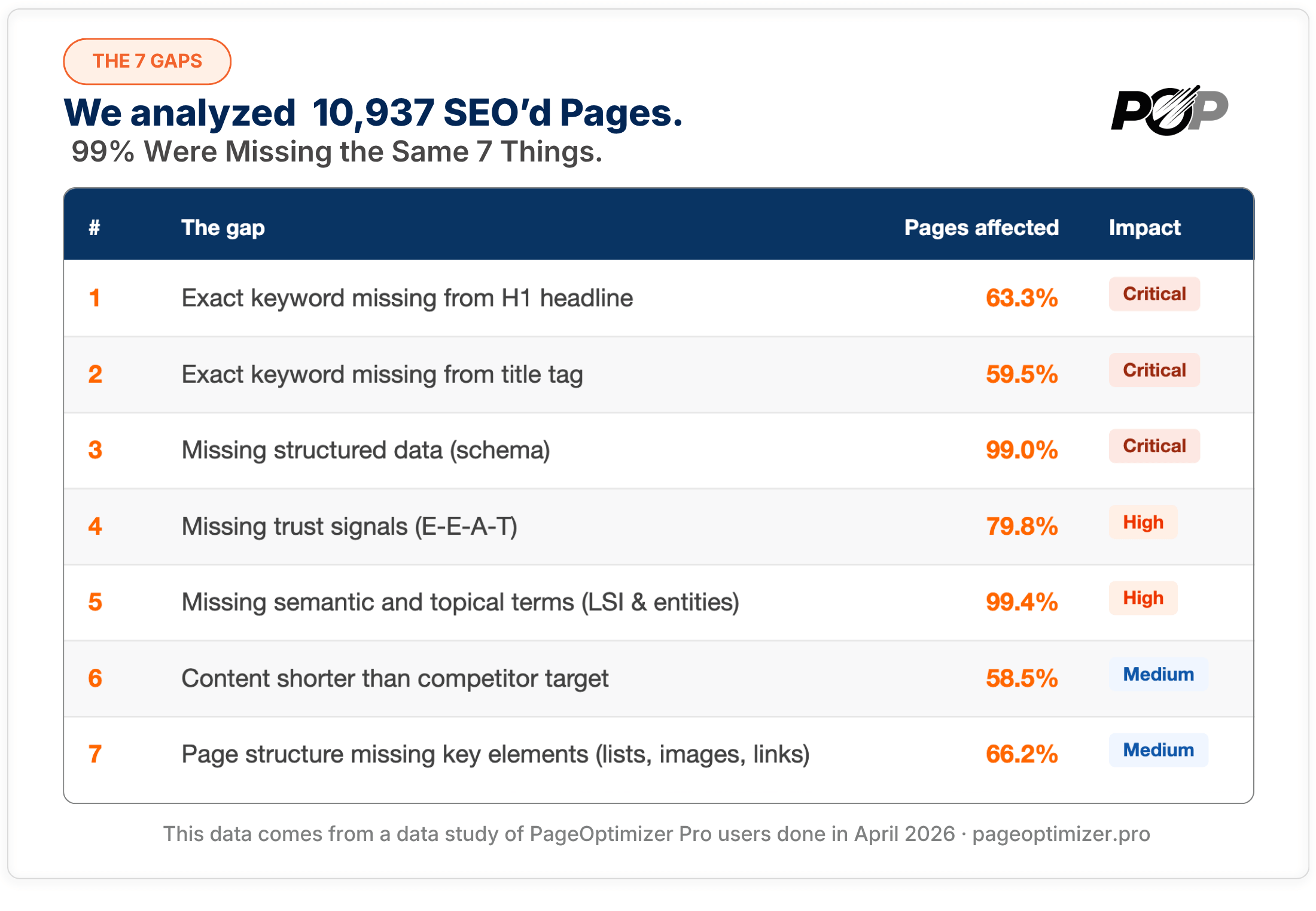
What we found: 7 gaps that show up on almost every page
Seven gaps. Same dataset. Most affect more than half of all pages. Here they are, in order we'll walk through them - starting with the easiest to fix.
We analysed 11 industries. One averaged a POP Score of just 14.8 out of 100. Where does yours rank?
See how your industry compares, where the biggest gaps are, and which basics competitors still miss.

%20(1).png)

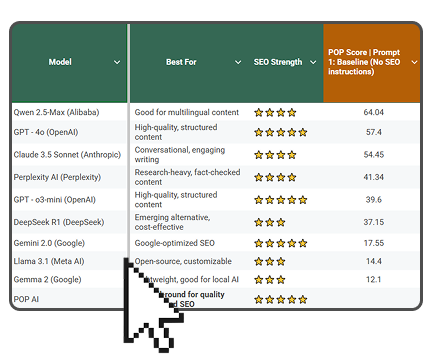
Which is the best LLM for SEO content?
Get the full rankings & analysis from our study of the 10 best LLM for SEO Content Writing in 2026 FREE!
- Get the complete Gsheet report from our study
- Includes ChatGPT, Gemini, DeepSeek, Claude, Perplexity, Llama & more
- Includes ratings for all on-page SEO factors
- See how the LLM you use stacks up
Finding 2: Schema Markup - The Biggest Gap Nobody Talks About
The most-missing schema types aren't exotic rich-result formats. They're foundational:
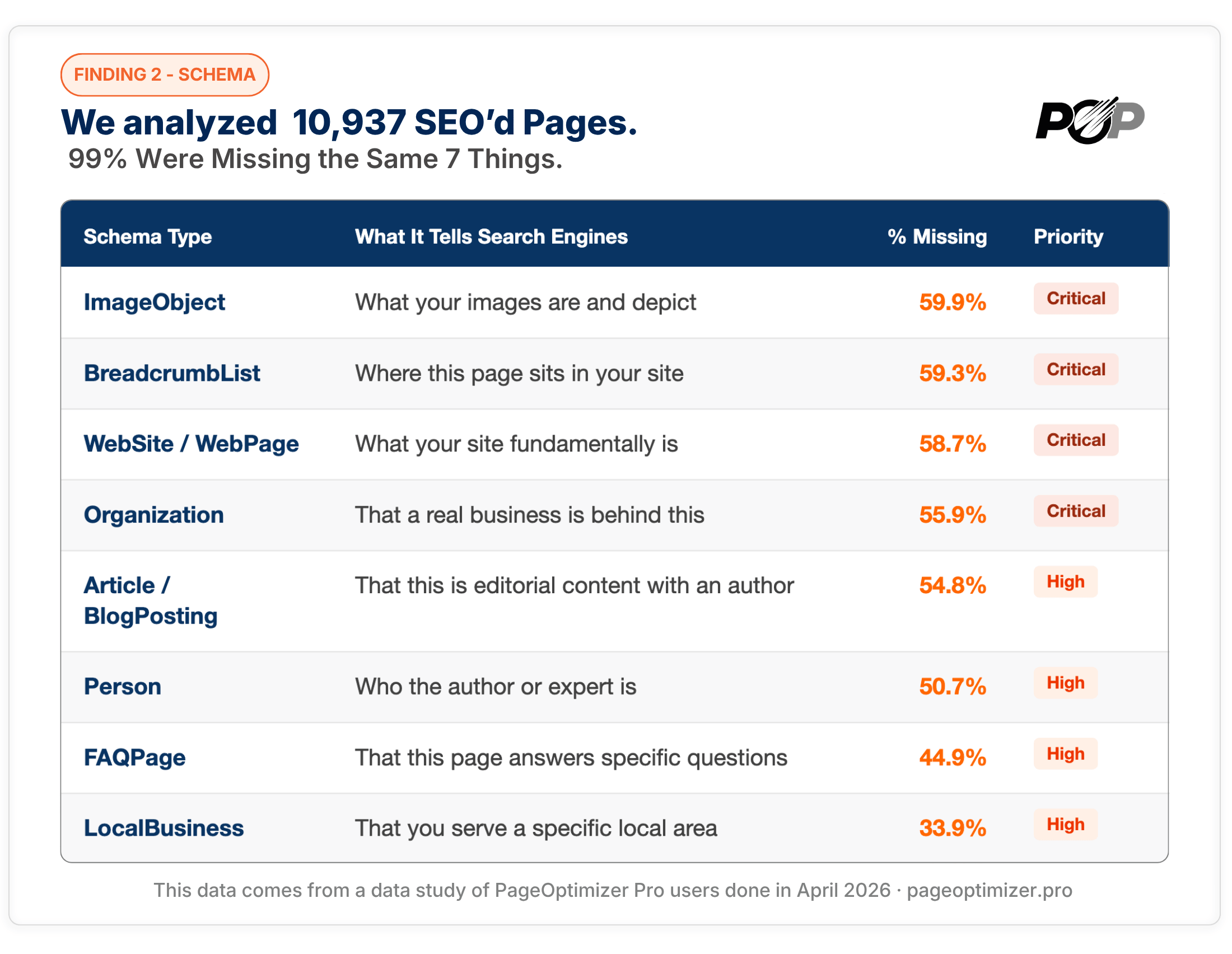
Start with the foundational types your competitors are already using. POP's rule: if at least 2 of your ranking competitors have a schema type, you probably should too. Foundational markup (Organization, Person, Article, BreadcrumbList, WebSite, ImageObject) covers the gap on most pages. You can generate it inside POP with one click, or use a CMS plugin like Yoast or RankMath.
When tools like ChatGPT, Perplexity, or Google's AI Overviews decide whether to cite your content, they rely heavily on structured data to understand what your page represents and whether it's trustworthy. A page with no Organization or Person schema is, to an AI, an unsigned document. Schema is how you sign your work.
Which is the best LLM for SEO content?
Get the full rankings & analysis from our study of the 10 best LLM for SEO Content Writing in 2026 FREE!
- Get the complete Gsheet report from our study
- Includes ChatGPT, Gemini, DeepSeek, Claude, Perplexity, Llama & more
- Includes ratings for all on-page SEO factors
- See how the LLM you use stacks up
Finding 4: LSI and Semantic Terms - The Language Google Uses to Understand You
What's revealing is where these terms are missing. It's not just in the body copy - it's in the supporting signals most content teams ignore entirely:
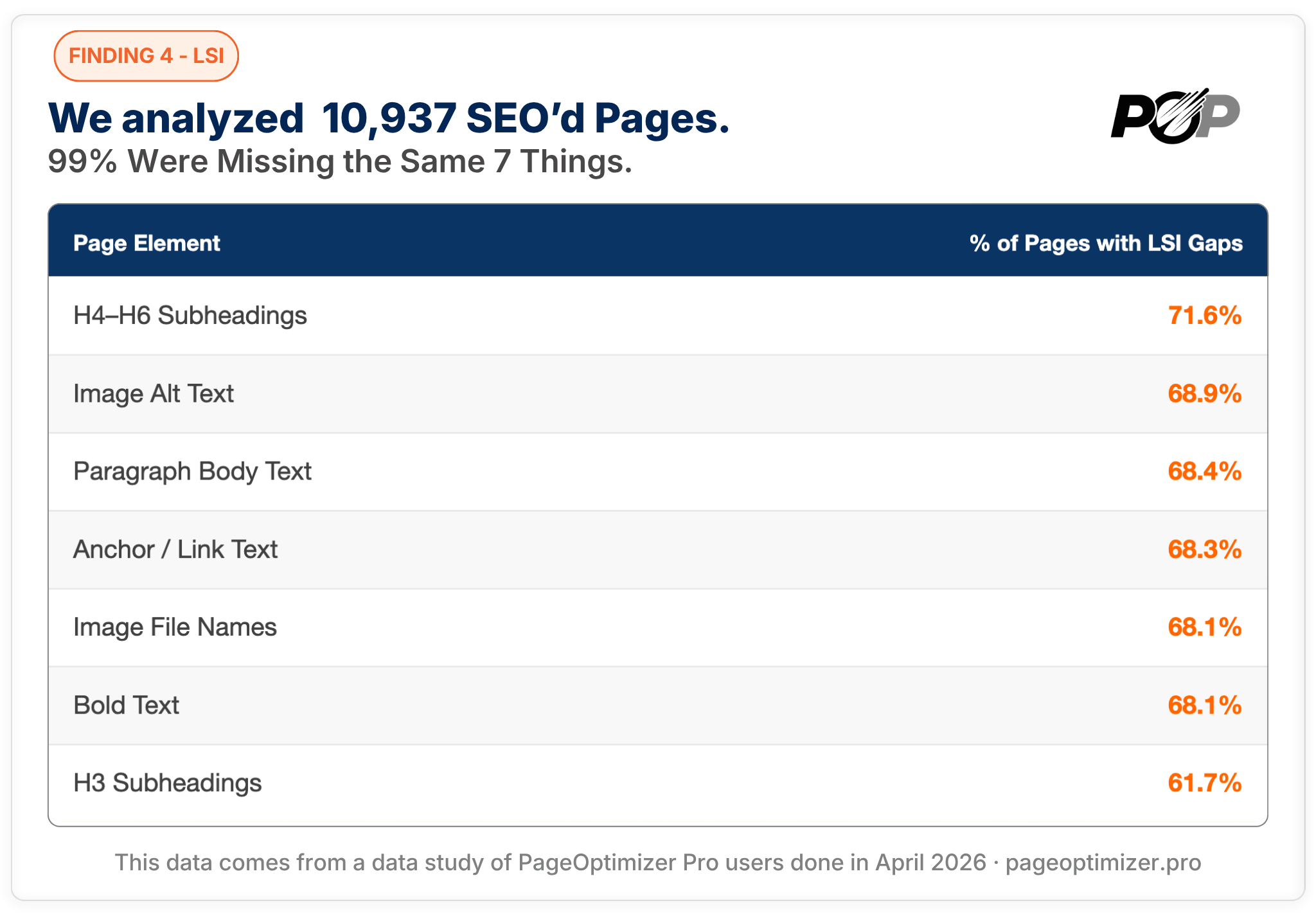
Modern on-page optimisation is not "put the keyword in the title." It's distributing the right topical language across every meaningful element of a page - including the places content teams almost never think about: image alt text, image file names, link anchor text, and subheadings.
Finding 6: Structural Signals - Formatting That Google Rewards
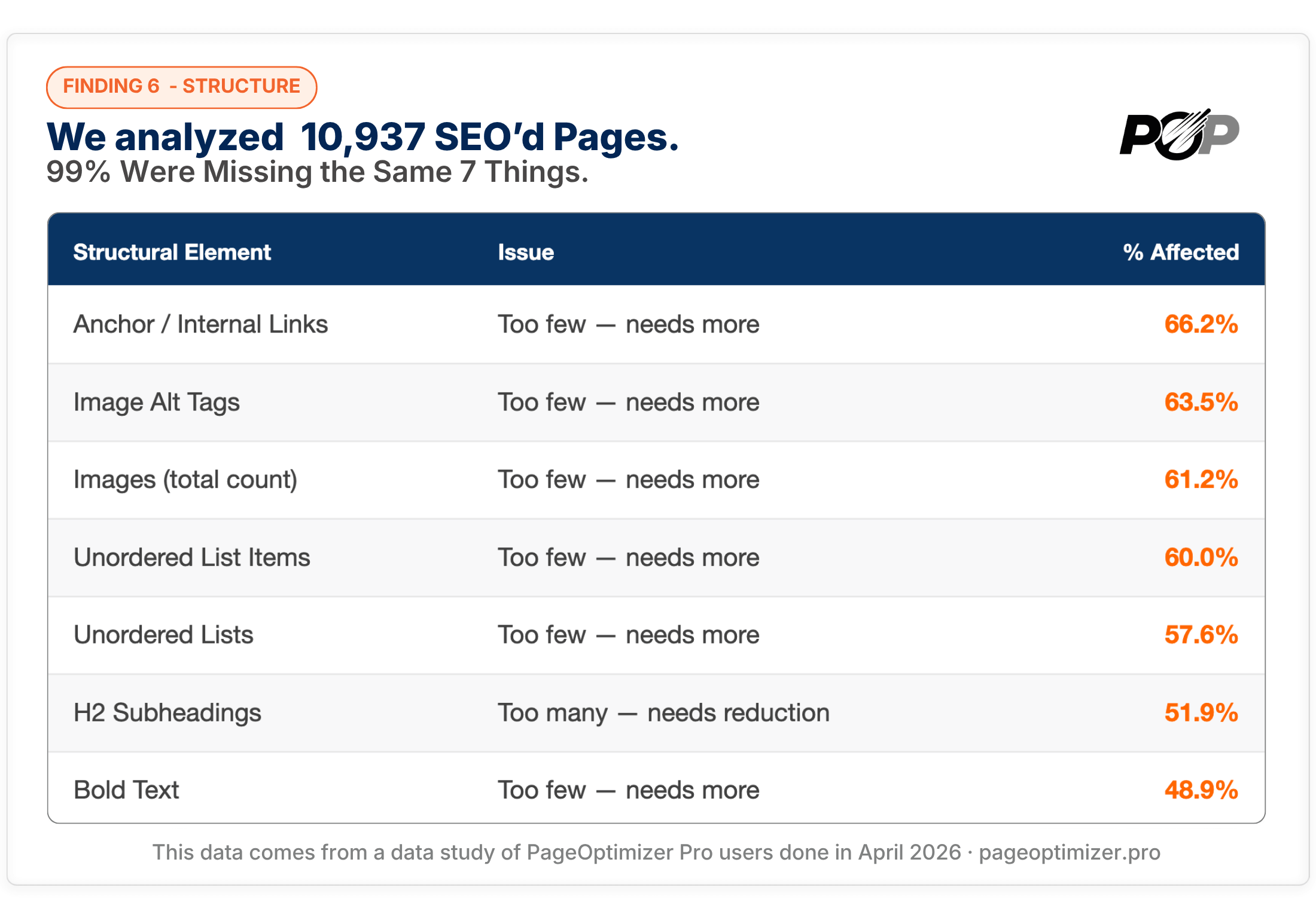
Structure isn't just "more is better." Over half of pages in our study had too many H2 subheadings - creating heading bloat that confuses both users and Google. The goal is matching the structure of pages currently ranking. Not piling on elements your competitors don't have.
Add what your competitors have that you don't: more internal links, more images with proper alt text, unordered lists, an FAQ section. Cut what they don't need: H2 bloat, paragraph bloat. The goal is to match the pattern of what's ranking - not max out any single element.
Finding 7: Page Type Breakdown - Your Money Pages Are Your Worst Pages

Category and landing pages - the most commercially important page type in any business's site - have the lowest average content score of all at 33.6. These are the pages driving traffic to your products and services. They have the worst H1 gaps (69.4%) and the highest short-copy rate (68.6%) of any page type. If you only optimise one page type on your site, start here.
We analysed 11 industries. One averaged a POP Score of just 14.8 out of 100. Where does yours rank?
See how your industry compares, where the biggest gaps are, and which basics competitors still miss.


Kyle Roof is a Co-Founder & Lead SEO at POP, SEO expert, speaker and trainer. Kyle currently resides in Chiang Mai, Thailand with his family.