Advanced on page SEO made simple.

Powered by POP Rank Engine™
Includes AI Writer
7-day refund guarantee
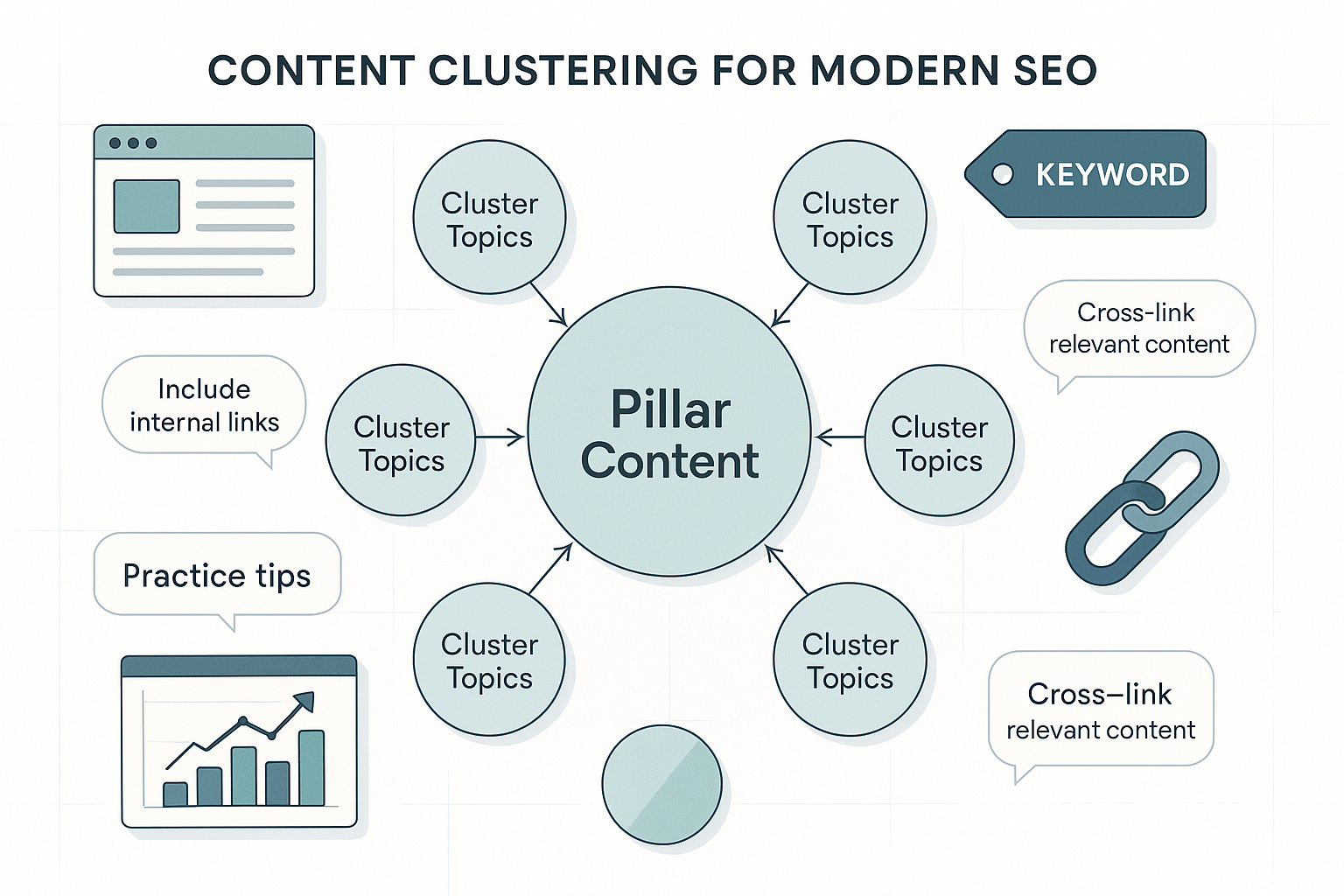
Content clustering has become a foundational practice for websites that want consistent organic visibility. As search engines improve their ability to understand relationships between topics, loosely organized pages struggle to compete. Sites that group related content clearly tend to show stronger topical signals, clearer internal linking, and better alignment with search intent.
Large language models, often referred to as LLMs, make this process faster and more accurate. They can analyze language at scale, identify relationships between documents, and surface patterns that are difficult to see through manual review alone. When those insights are paired with correlational SEO data, content clustering becomes both structured and performance-driven.
Instead of guessing how pages should be grouped, teams can rely on language understanding and competitive evidence. That combination helps build clusters that support both users and search engines while remaining flexible as content libraries grow. Read on to find out more about how LLMs help with content clustering.
We analysed 11 industries. One averaged a POP Score of just 14.8 out of 100. Where does yours rank?
See how your industry compares, where the biggest gaps are, and which basics competitors still miss.

%20(1).png)

Which is the best LLM for SEO content?
Get the full rankings & analysis from our study of the 10 best LLM for SEO Content Writing in 2026 FREE!
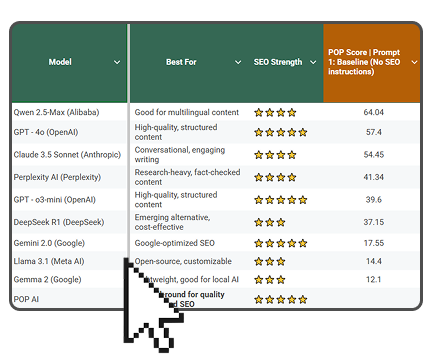
- Get the complete Gsheet report from our study
- Includes ChatGPT, Gemini, DeepSeek, Claude, Perplexity, Llama & more
- Includes ratings for all on-page SEO factors
- See how the LLM you use stacks up
Why Content Clustering Matters for Modern SEO
Search engines no longer treat pages as isolated assets. They evaluate how pages relate to each other and whether a site demonstrates clear topical focus. Content clustering addresses this by organizing pages around shared themes, supported by internal links and consistent language.
A well-structured cluster helps search engines understand subject depth. It also helps users navigate naturally from broad topics to more specific answers. When clustering is weak, sites often suffer from overlapping pages, unclear intent, and internal
competition between URLs.
As content volume increases, clustering becomes harder to manage manually. Pages published months or years apart may cover similar ground without clear differentiation. LLMs help resolve this by reading content as a whole and identifying how pages relate based on meaning rather than surface keywords.
How Large Language Models Support Text Clustering and Topic Modeling
Large language models excel at semantic analysis. They process language patterns across large sets of documents and identify shared concepts, intent signals, and contextual similarities. In text clustering, this allows them to group pages based on meaning rather than just keyword overlap.
Traditional text clustering methods often rely on frequency counts or simple similarity metrics. LLM clustering goes further by understanding how topics connect and how users are likely to interpret those connections. This results in clustering that feel natural rather than forced.
Topic modeling becomes more precise with LLM support. Pages that appear different on the surface can be grouped together if they address the same underlying questions. At the same time, pages that share keywords but serve different purposes can be separated to avoid cannibalization.
For SEO teams, this improves clarity. Instead of maintaining clustering text that grow messy over time, LLMs help refine which pages belong together and which need repositioning. This supports cleaner internal linking, clearer page roles, and stronger topical signals. Large language model (LLM) embeddings can enhance traditional text clustering methods.
Which is the best LLM for SEO content?
Get the full rankings & analysis from our study of the 10 best LLM for SEO Content Writing in 2026 FREE!
- Get the complete Gsheet report from our study
- Includes ChatGPT, Gemini, DeepSeek, Claude, Perplexity, Llama & more
- Includes ratings for all on-page SEO factors
- See how the LLM you use stacks up
Building SEO-Focused Clusters with LLMs and Page Optimizer Pro
A practical clustering workflow starts with content analysis. LLMs review existing pages and generate summaries that describe what each page covers, who it appears to target, and which topics it supports. This creates a usable inventory that reflects meaning, not just metadata.
From there, pages can be grouped into initial clusters based on shared themes. At this stage, LLM output highlights overlaps, gaps, and opportunities for consolidation or expansion. Some pages may need clearer positioning. Others may need supporting content added to strengthen the cluster.
This is where a tool like Page Optimizer Pro (POP) becomes critical. POP evaluates pages within a cluster against competitive SERPs and identifies on-page elements that correlate with strong performance. Instead of assuming how a cluster should be structured, teams can see how top-ranking pages distribute content, terminology, and
internal links.
Edits then focus on alignment. Pages within a cluster should support each other without repeating the same intent. Headings, internal links, and topic coverage can be adjusted based on both LLM insight and correlational data.
This approach turns clustering into an ongoing system rather than a one-time project. As new pages are added, they can be evaluated against existing clusters and refined before creating overlap.
Avoiding Common Clustering Issues with Model-Assisted Analysis
While LLMs speed up clustering, they are not infallible. One common issue is over- grouping. Pages may appear related semantically but still serve different user needs. Human review is necessary to confirm intent alignment.
Another risk is uniformity. If every cluster follows the same structure, sites can lose clarity in positioning. LLMs should be used to surface relationships, not dictate final architecture. Editorial judgment ensures clusters remain useful and distinct.
There is also the risk of ignoring performance data. A page may appear out of place based on language alone but still perform well in search. Removing or merging such pages without validation can harm visibility. A tool like POP helps prevent this by showing which pages earn rankings and which signals contribute to that success.
Strong clustering balances language analysis with measurement. LLMs identify patterns. POP confirms which patterns align with competitive results. Teams then decide how to act.
Scaling Content Clustering for Long-Term Visibility
As websites grow, clustering must scale with them. Manual methods break down when content libraries reach hundreds or thousands of pages. LLM-based clustering allows teams to revisit structure regularly without starting from scratch. This supports long term visibility in several ways. Clusters stay clean as new content is added. Internal links remain purposeful. Topic coverage evolves without creating confusion for users or search engines.
For teams researching how LLMs help with content clustering, the real advantage lies in repeatability. Language models reduce friction in analysis. A tool like POP reduces uncertainty in optimization. Together, they support a structured system that grows alongside the site.
If you want your content clustering to align with how search engines evaluate topical relevance, Page Optimizer Pro helps you validate structure and on-page signals using competitive data. Pair POP with LLM-assisted clustering to build scalable site architecture backed by evidence.
We analysed 11 industries. One averaged a POP Score of just 14.8 out of 100. Where does yours rank?
See how your industry compares, where the biggest gaps are, and which basics competitors still miss.


Kyle Roof is a Co-Founder & Lead SEO at POP, SEO expert, speaker and trainer. Kyle currently resides in Chiang Mai, Thailand with his family.