The short version
Armstrong runs two fitness sites in Australia. He had plenty of SEO ideas but no certainty about what would actually work, so he booked a 1-on-1 with Kyle Roof and executed the strategy they built. One site went from 14 clicks a day to around 1,000; the other jumped from 27 to 200 overnight. Both earned over 1,500 AI citations and around $1,000 a month in AdSense as a byproduct.
→ Jump straight to how he did it
About Armstrong
Armstrong has been a personal trainer for ten years and runs a personal training and fitness business across two sites with different branding, Fitness Network and Fitness Image, serving Melbourne and beyond. He offers online coaching, nutrition plans, and a local in-person service.
It's the same business behind both brands, and launching the second site alone doubled his traffic and his leads. But the real transformation came later, from one strategy he ran across both sites.
Running two sites on the same keywords has a strategic logic to it. Targeting the same terms from two different sites is effectively two chances to rank for each one. And because Google personalizes results heavily, it will often serve different searchers a different site, so two footprints cover more of the results than one ever could. Armstrong has seen this play out first-hand: he says he'll sometimes never see one of his own sites in the results himself, yet still gets inquiries through it constantly. Rather than fight that unpredictability, he leaned into it, and it paid off in 2x the leads.
Rather than hire an agency, Armstrong booked a 1-hour private consultation with Kyle Roof to gain clarity on his SEO, and then executed the strategy himself.

The Challenge
Armstrong wasn't short on effort or ideas. He was short on certainty. Like many business owners, he faced conflicting SEO advice and was unsure which activities would actually move the needle.
Part of what made it so frustrating was watching sites that seemed to do everything wrong still rank, without understanding why they did.
That uncertainty had a real cost: it stopped him from executing. He didn't want to pour months into writing hundreds of pages only to find out the whole strategy had been slightly off.
So before scaling anything, he booked a call to get clear on the strategy first.
The Solution
The call gave Armstrong a strategy he could trust and repeat. His main takeaway was the ability to look at any page and understand why it ranks: what the page is doing, what the strategy behind it is. Before, he wasn't sure what to focus on.
With that clarity, Armstrong committed to a single method and executed it consistently: the reverse-silo article strategy Kyle walked him through on the call. The idea is straightforward: publish a steady stream of supporting articles, structure them as a reverse silo, and use them to push one money page up the rankings in Google and in AI search.
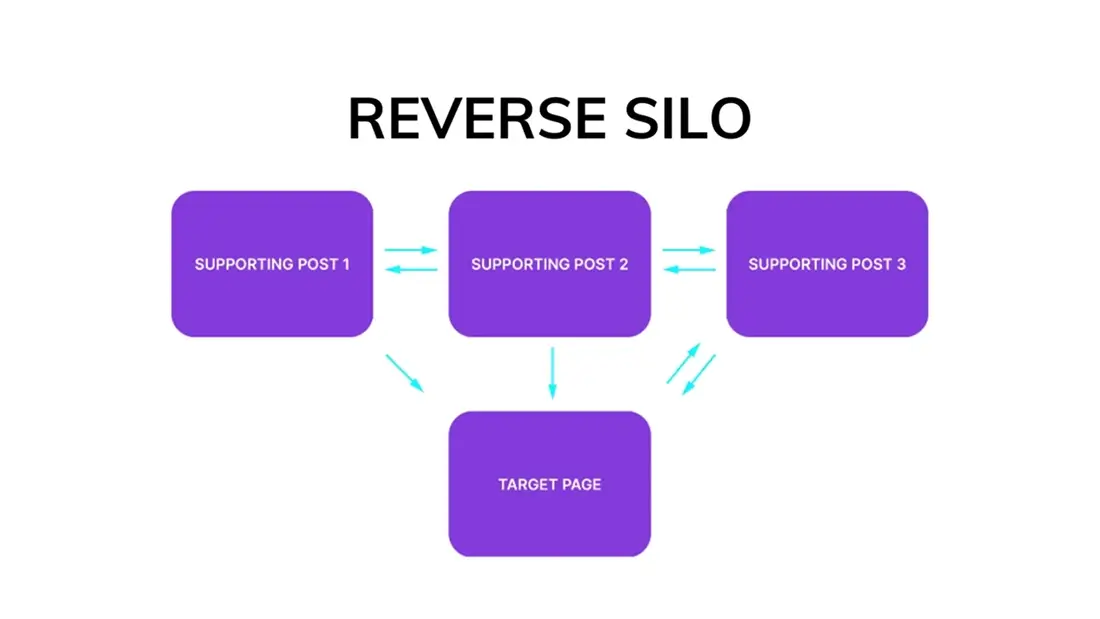
Here is the workflow Armstrong followed to build it.
The workflow
Step 1: Focus on the 80/20 and execute
Armstrong's first change was to stop chasing every tactic he came across on Instagram or Twitter and concentrate on the small share of work that drives most of the result. It's the 80/20 rule applied to SEO: find the thing that actually moves the needle, then focus on executing that. In his experience, most people, agencies included, never settle on a core strategy at all.
Step 2: Write within your traffic tier
At the core of the strategy was writing a steady stream of articles, chosen through keyword research and sized to the traffic tier each site was actually in, rather than writing on interest alone.
💡 What is a traffic tier?
A traffic tier is the level of keyword opportunity your site can realistically compete for right now.
This method groups websites into tiers based on their average monthly traffic. When you arrange those tiers from lowest to highest, the system looks like this:
/
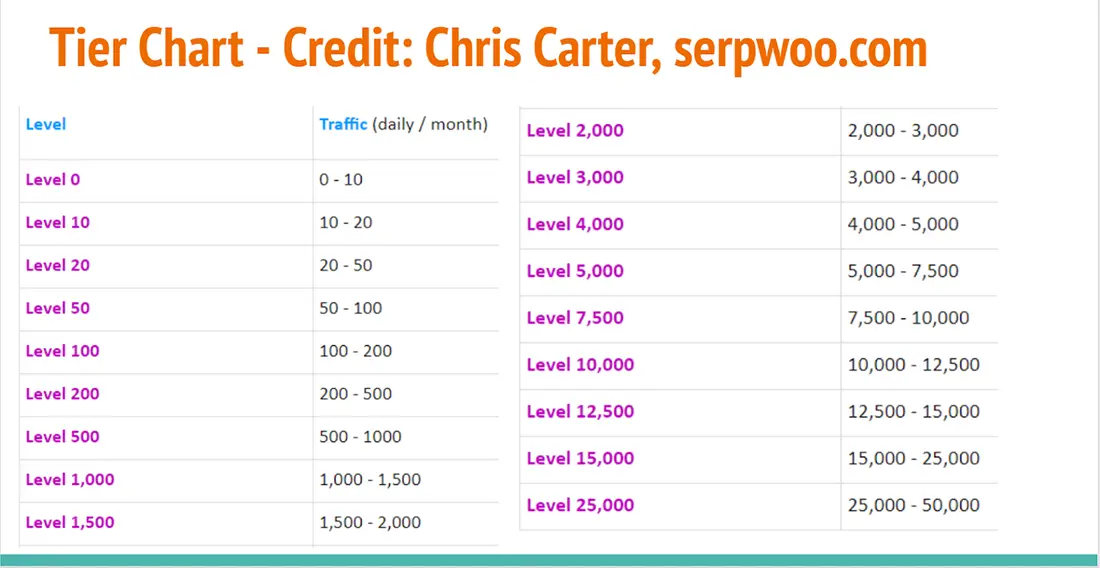
Keywords within your current tier are the ones you can often rank for quickly with solid on-page optimization. Keywords above that tier may need more time, stronger supporting content, heavier optimization, and additional authority before they move.
The goal is not to stay at the lower levels forever. Start where your site can win, use those pages to build impressions, clicks, links, and site strength, then move up to more competitive opportunities over time.
Armstrong applied this by finding article topics sized to what each site was already pulling. As he puts it, a lot of people just write good articles about what they think, which is never going to rank; the whole strategy was keyword research, finding articles in the traffic tier your site is actually in.
To source topics, Armstrong followed the keyword workflow from the call. He used Google Trends and the People Also Ask section in Google: take a rising term, enter it into Google, and pull article ideas from the expanding People Also Ask questions, then check search volume and keyword difficulty before deciding what to write.
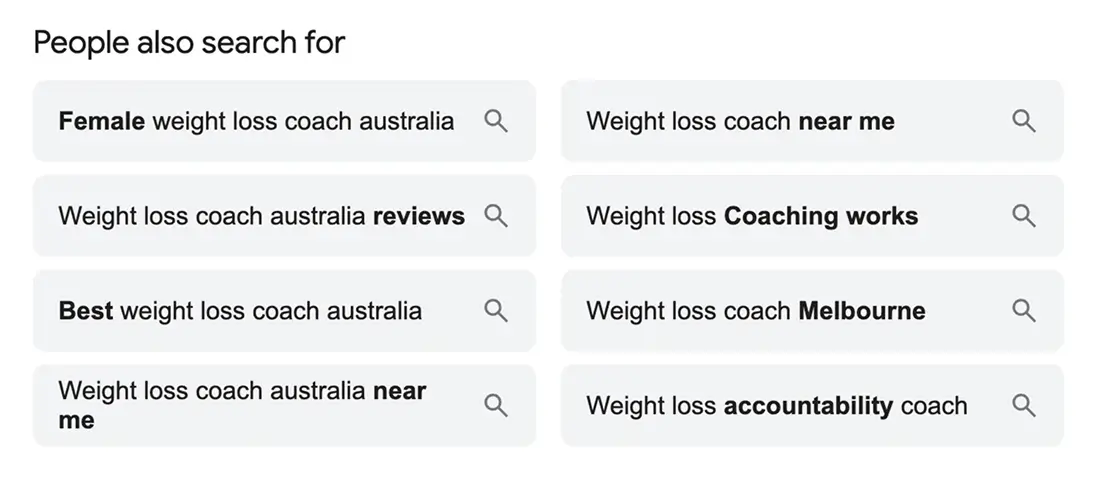

Topics that look only loosely related can still convert. Armstrong points to a client who paid $600 for online coaching after finding one of his articles by searching for the price of Ozempic, a search with no obvious link to personal training that still turned into a paying customer.
Kyle also suggested one complimentary strategy: putting the secondary keyword in the H2s.
In the beginning, Armstrong published two to four articles a day across both sites.
Step 3: Build the reverse silo
With the articles written, Armstrong interlinked them into a reverse silo: all the articles link to each other selectively, and each one links to the single money page he wanted to rank (what POP calls the Top-Level Page).
On top of the silo, the whole site was structured as a hub and spoke, from the homepage to the blog, with blog posts interlinking and pointing back to the money page. As Armstrong notes, you have to keep up the cadence, because it works.
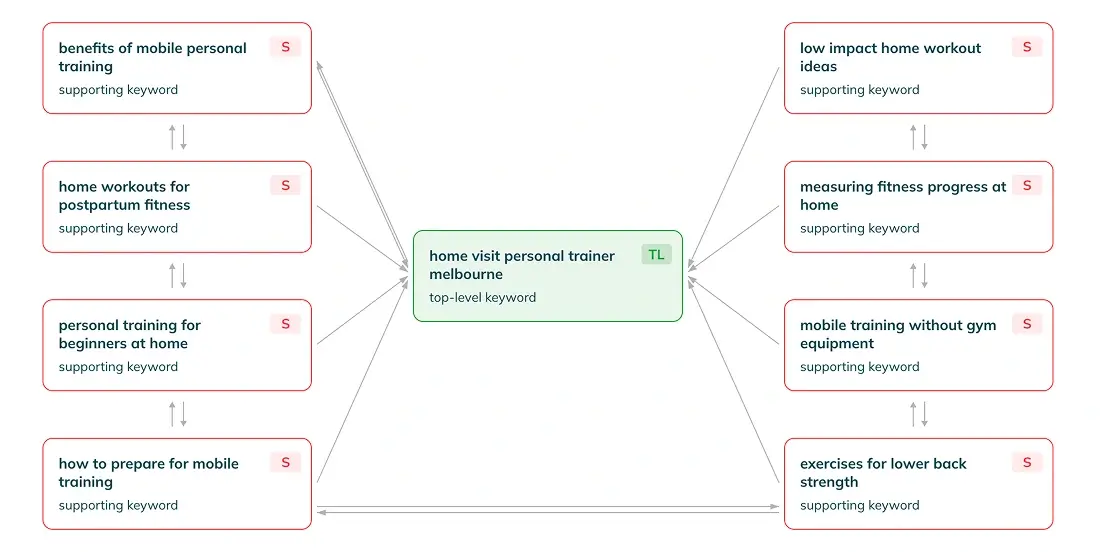
💡 BUILD YOUR SILO IN ONE CLICK WITH POP
Did you know POP can build the whole silo structure for you?
With One-Click Silo, you enter your main keyword and POP analyzes 60–70 related keywords, groups them by intent, and builds a complete structure - one Top-Level Page plus its supporting pages - with the internal-link mapping already done. No spreadsheets, no manual planning: the reverse silo, mapped out for you in a click.
Step 4: Automate the interlinking
With a handful of articles, you can interlink them yourself by following the silo map. But Armstrong was publishing at volume across two sites, and tracking every link by hand meant a large, fragile spreadsheet. So his recommendation is to let AI build the silo: give it the links to your articles and the reverse-silo diagram Kyle demonstrates ("that's the exact thing we're doing"), and have it return the HTML linking snippets to paste into each article.
The unexpected AdSense income
Armstrong did not run this strategy for ad revenue; he ran it to rank his money pages. Because the articles brought in real traffic, the AdSense he had placed on the site began returning around $1,000 a month in profit, which he leaves untouched. Each article also included an ebook, which brought in 10 to 15 email signups a day.
Results
Armstrong ran the same strategy across two sites.
His main local service site started slowly around September at 14 clicks a day, then ramped up gradually before increasing to around 1,000 clicks a day.
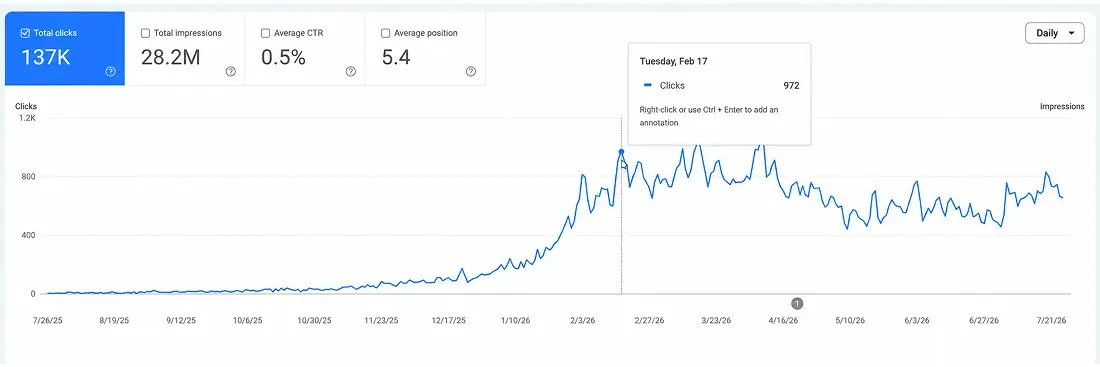
Then the second site did something even harder to believe. Armstrong went to bed with it sitting at 27 clicks a day and woke up to 200.
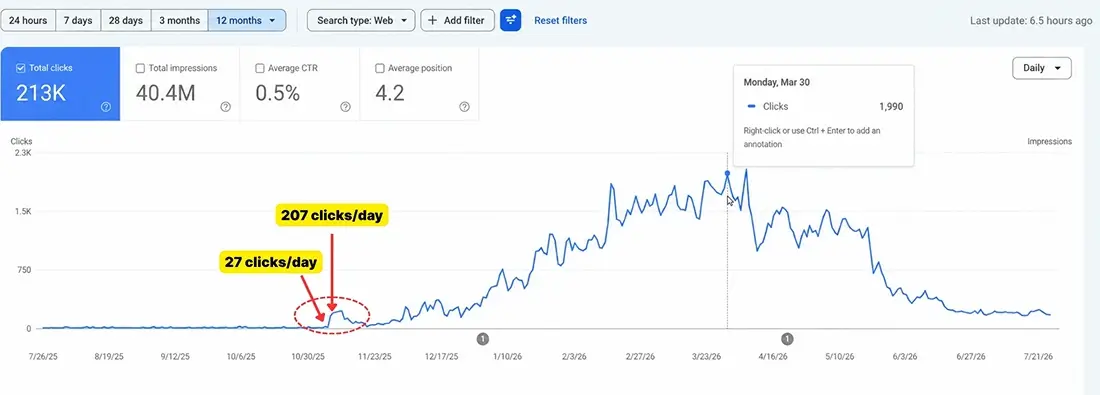
For a local service site, that scale is almost unheard of. According to Armstrong, a normal service site gets about 12 clicks a day. His was doing close to 1,000, and by the time of the interview he'd dialed the effort right down to a single article a day.
Add it up: a thousand clicks a day on repeat, a thousand a month in AdSense profit, plus the inquiries and the website boost, on about five minutes of work a month.
The traffic did later come back down. Armstrong is upfront about why: around February he stopped posting articles to focus on the rest of his business. Notably, traffic kept climbing for a couple of months after he stopped before it began to dip, so the decline followed the pause in production, not any failure of the strategy itself. He has since started posting again.
AI citations
Alongside the rankings, Armstrong's sites earned a large number of AI citations, around 574 on one site, roughly 1,000 on the other, and a couple thousand across all his sites. These required no additional work; they came straight out of the article structure, answering the People Also Ask question directly and using the complimentary H2 tactic Kyle suggested. Armstrong says he gets customers from ChatGPT all the time, because the articles answer the question directly, straight away.
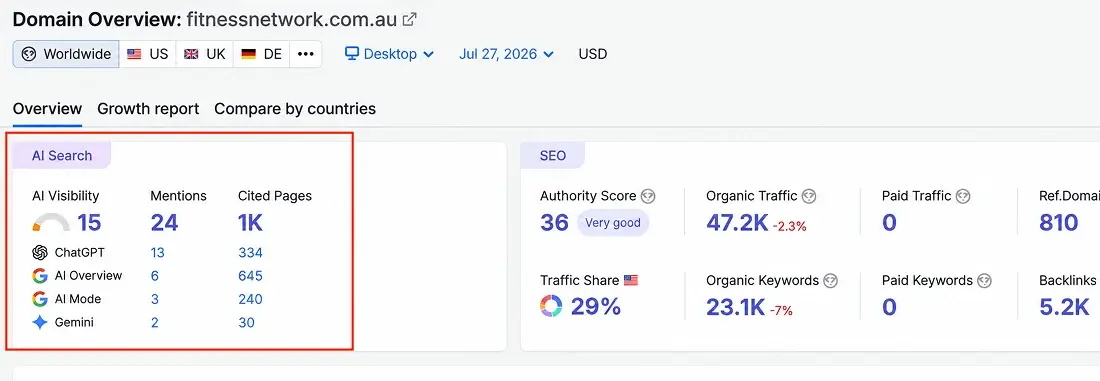
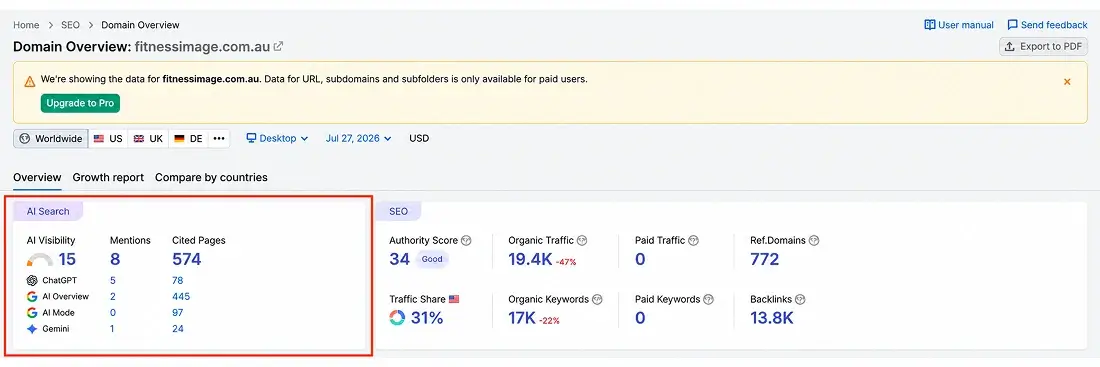
He runs into the citations himself, too. When he's doing his own business-development research in ChatGPT or Perplexity, his own sites show up as references, cited for things like personal-training statistics, which he finds equal parts useful and funny.
At its peak, Armstrong reports the second site reached roughly 2,000 daily clicks in Google Search Console, or about 60,000 clicks over a 30-day period.
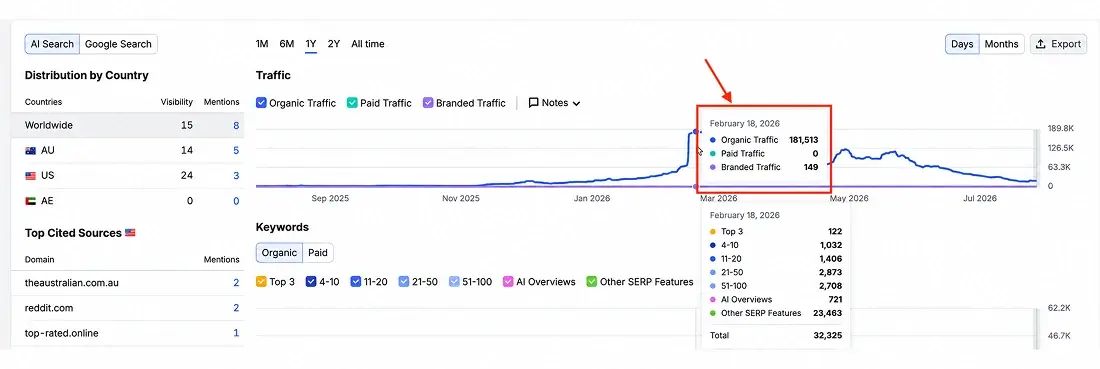
The results didn't come from the 1-hour SEO strategy call alone. The call gave Armstrong the strategy and the clarity to know what to focus on, but the traffic came from what he did with it: writing two to four articles a day across both sites, by hand at first, an hour or two every day, until he'd built systems to speed it up. He committed to one strategy and ran it, consistently, and that's what turned it into traffic.
His own advice to anyone still stuck: if you're on the fence, or just confused about SEO, book a call with Kyle, get your questions answered, and get on with actually doing SEO.
Want to achieve similar results?
Three ways to start, whatever your appetite for the work.