We Tested 12 New “Best-for-Writing” LLMs for SEO Content in 2026

Here’s Why POP AI Writer Still Wins

(The gap isn’t small. It’s huge.)

Advanced on page SEO made simple.

Try POP today

Powered by POP Rank Engine™

Includes AI Writer

7-day refund guarantee

Kyle Roof presents the results of the best LLM for SEO content writing case study on stage.

Ask any AI tool to “write SEO-friendly content” and it will confidently produce something that looks publish-ready.

But if you’ve ever published that content with the expectation it would rank in Google, generate traffic, and even be picked up in LLMs.. And then waited only to watch it stall (or not even get indexed), you already know there is a problem:

Writing well isn’t the same thing as writing content that search engines understand and reward. 

So we ran the same kind of head-to-head test as the original PageOptimizer Pro LLM study, but updated for 2026, with newer “writing-first” models and a few that marketers swear are great for SEO. 

And yes, the winner is still the one tool that combines the best of AI generated content writing with technical, scientific, SEO signals (over 100) that gets content performing in Google and more often featured in LLMs.. Want to guess which tool is the winner in 2026?

Which is the best LLM for SEO content?

Get the full rankings & analysis from our study of the 10 best LLM for SEO Content Writing in 2026 FREE!
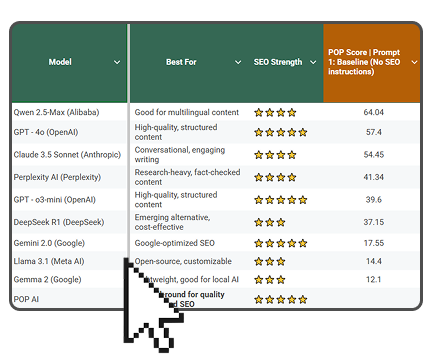
  • Get the complete Gsheet report from our study
  • Includes ChatGPT, Gemini, DeepSeek, Claude, Perplexity, Llama & more
  • Includes ratings for all on-page SEO factors
  • See how the LLM you use stacks up
Thank you! Your submission has been received.
Oops! Something went wrong while submitting the form.

The common assumption about AI + SEO

Most people assume:

“If the writing is good, Google will figure it out.”


That used to be sometimes true when competition was low.

In 2026, it’s not.

Today, the pages that move are the ones that hit structure + topical coverage + semantic relevance consistently. Not just “nice paragraphs.” 

What we tested in 2026

We compared 13 options total:

  • 12 major LLMs (newer 2026-era picks, plus a few staples)
  • POP AI Writer (inside PageOptimizer Pro)

Each model got two shots:

Part 1: Baseline prompt (no SEO instructions)

Prompt (Baseline): “Write an article about [topic]. Output HTML.” (No keyword lists. No optimization instructions. Just raw output.)

Part 2: “SEO-optimized” prompt

Prompt (SEO): “Write an SEO-optimized article about [topic]. Output HTML.”

Then we scored every output using POP-style on-page criteria (the same “does this page actually look rankable?” approach).

Which AI models did we test against POP AI Writer for SEO? 

Claude Sonnet 4.6 (Anthropic)
A balanced high-performance model optimized for reasoning, structured writing, and contextual understanding. Designed for clarity, long-form generation, and enterprise reliability.
Visit Claude
Claude Opus 4.6 (Anthropic)
Anthropic’s most advanced reasoning model. Built for deep analytical tasks, high-accuracy outputs, and complex content generation across technical and research domains.
Visit Claude
Gemini 3 Pro (Google/DeepMind)
Google’s advanced multimodal AI model developed with DeepMind. Strong in reasoning, search alignment, and web-context awareness, built to integrate seamlessly with Google’s ecosystem.
Visit Gemini
GPT-5.2 (OpenAI)
A next-generation OpenAI flagship model designed for advanced reasoning, long-context processing, and highly structured content generation across professional use cases.
Visit OpenAI
GPT-4.1 (OpenAI)
An evolution of GPT-4 optimized for better instruction-following, reliability, and structured outputs. Widely used for SEO writing, automation, and enterprise workflows.
Visit OpenAI
Llama 4 Maverick Instruct (Meta, open-weight)
Meta’s open-weight instruction-tuned model designed for customization and developer flexibility. Ideal for teams that need control over deployment and fine-tuning.
Visit Meta
Perplexity Pro (Sonar / Sonar Deep Research)
A research-focused AI model integrating retrieval and reasoning. Known for real-time web access and citation-backed outputs tailored for analytical and news-style content.
Visit Perplexity
Grok 4 / Grok 4.20 Beta (xAI)
Developed by xAI, Grok integrates real-time social data from X. Positioned for fast, culturally aware responses and trend-sensitive content generation.
Visit xAI
Mistral Large 3 (Mistral)
A European-developed large language model focused on performance and efficiency. Known for strong multilingual capabilities and open deployment options.
Visit Mistral
DeepSeek V3.x (DeepSeek)
An emerging AI model optimized for reasoning efficiency and cost-performance balance. Positioned as a competitive alternative in technical and coding tasks.
Visit DeepSeek
Qwen 3.5 (Alibaba)
Alibaba’s multilingual AI model designed for global adaptability. Strong in cross-language generation and regional content customization.
Visit Qwen
Doubao 2.0 / Seed 2.0 Pro (ByteDance)
ByteDance’s AI initiative focused on large-scale conversational models. Built to integrate with content ecosystems and consumer-scale applications.
Visit ByteDance
POP AI
Unlike traditional LLMs, POP is built specifically for SEO. It relies on its proprietary RankEngine™ combined with layered AI systems to generate content structured for ranking performance.
Visit POP

Which is the best LLM for SEO content?

Get the full rankings & analysis from our study of the 10 best LLM for SEO Content Writing in 2026 FREE!

  • Get the complete Gsheet report from our study
  • Includes ChatGPT, Gemini, DeepSeek, Claude, Perplexity, Llama & more
  • Includes ratings for all on-page SEO factors
  • See how the LLM you use stacks up
Thank you! Your submission has been received.
Oops! Something went wrong while submitting the form.

What we measured (and why it matters)

Here’s what the attached 2026 dataset evaluated:

  • POP Score (overall on-page optimization score)
  • Title tag present (0/1)
  • Page title (H1) present (0/1)
  • Subheadings count target: 5–9
  • Main content coverage target: 183–305
  • Google NLP term coverage target: 19–86
  • Readability + word count (useful context, but not the main ranking signal)

In the original POP study, the key takeaway was simple:

Most content starts moving when it hits ~80+ POP score. 

So… how many models got there?

The headline result (2026): only one option broke a score of 80

Across all 13 entries in the SEO-prompt test:

  • Average POP score (SEO prompt, excluding POP AI): 58.41
  • PBest non-POP model: 72.80
  • Models reaching 80+: 1 out of 13
  • That one model? POP AI (100).

Let that sink in.

You can use the “best” mainstream model… and still end up an entire tier below what POP considers “strong enough to move.”

The full 2026 rankings (SEO prompt results)

(From the attached dataset; 1 = present, 0 = missing)

Model SEO POP Score SEO Search Engine Title SEO Page Title SEO SubHeadings SEO Main Content SEO Google NLP
POP AI 100 1 1 8 206 85
GPT-4.1 (OpenAI) 72.8 1 1 4 81 12
Claude Opus 4.6 (Anthropic) 71.57 1 1 4 78 24
DeepSeek V3.x (DeepSeek) 71.48 1 1 4 94 18
Gemini 3 Pro (Google/DeepMind) 70.92 1 1 4 103 28
Grok 4 / Grok 4.20 Beta (xAI) 68.65 1 1 4 81 13
Mistral Large 3 (Mistral) 67.17 1 1 4 67 15
Doubao 2.0 / Seed 2.0 Pro (ByteDance) 54.6 0 1 5 70 18
Claude Sonnet 4.6 (Anthropic) 52.44 0 1 4 82 18
Qwen 3.5 (Alibaba) 49.68 0 1 4 90 28
GPT-5.2 (OpenAI) 49.1 0 1 4 109 16
Perplexity Pro (Sonar / Sonar Deep Research) 47.12 0 1 3 127 29
Llama 4 Maverick Instruct (Meta, open-weight) 25.35 0 0 0 90 23

What jumps out immediately

The average model is failing the structure targets:

  • Subheadings target 5–9: only 2/13 hit it (POP AI + one other)
  • Main content target 183–305: only 1/13 hit it (POP AI)
  • Title tag included: only 7/13 included one at all

And the biggest pattern of all:

✅ Many models can produce decent prose
❌ Most models do not reliably produce rank-ready on-page structure

“SEO prompt” helped… but it still didn’t solve the SEO problems

Yes, some models improved massively when you added the word “SEO” to the prompt.

Here are the biggest jumps (baseline → SEO prompt):

Model Baseline POP Score SEO POP Score Delta
DeepSeek V3.x 17.96 71.48 +53.52
Gemini 3 Pro 31.53 70.92 +39.39
Grok 4 37.65 68.65 +31.00
Claude Opus 4.6 46.88 71.57 +24.69

But here’s the trap:

Even the “big winners” still topped out in the low 70s.
That’s better… but it’s not “this page is dialed in.”

Even worse: a couple of models lost optimization score when asked to “do SEO” (in the dataset, Perplexity and Qwen dropped).

Translation:

“SEO-optimized” is not a reliable instruction.

Why POP AI Writer wins (and why it’s not a fair fight, in a good way)

POP AI Writer is built differently.

It’s not trying to guess what SEO means.

It uses POP’s proprietary Rank Engine to create a set of data-driven instructions (see https://pageoptimizer.pro/pop-pro for specific details) that the POP writer then uses to generate content that’s aligned to the data, either using Auto Writing (speed) or Guided Writing (control). 

The POP Score measures how well a page has been optimized for a keyword.

And the winner is… 🥇
POP AI Writer hit everything that other LLMs kept missing
  • Title tag: ✅
  • Page title: ✅
  • Subheadings in range (5–9): ✅ (it produced 8)
  • Main content in range (183–305): ✅ (it hit 206)
  • Google NLP terms in range: ✅ (85, within the dataset range)
That’s how you get a score of 100.
Not “better writing.”
Better alignment to what ranking pages are already doing, consistently.

So… when should you use POP AI Writer?

If you care about rankings, indexing consistency, and speed, the workflow is pretty clear:

Use regular LLMs for:

  • brainstorming angles
  • expanding outlines
  • tone/voice experimentation
  • quick rewrites


Use POP AI Writer for:

  • the final draft you actually publish
  • updating pages you want to move fast
  • anything competitive where “pretty good” doesn’t cut it

Because the data is saying the quiet part out loud:

Most LLMs can write.
POP AI Writer can write and optimize.

★★★★★
Reached page 1 for competitive keyphrases where I before lingered around page 3 or 4 for years
POP was the first SEO software where I could really see what my changes were doing. I reached page 1 for competitive keyphrases where I before lingered around page 3 or 4 for years. POP works. Period. I have gained Google 1 to 3 positions on important keywords. Most importantly: Since using POP, more qualified leads have come in.
Henning Geiler
Henning Geiler


In this 2026 dataset, the “best” non-POP LLM output topped out at 72.8.

POP AI Writer scored 100.

If you’re publishing AI content and hoping it ranks, the safest move is to stop relying on generic prompts and start using a system that’s built to hit on-page targets by design.

blog author kyle roof

Kyle Roof is a Co-Founder & Lead SEO at POP, SEO expert, speaker and trainer. Kyle currently resides in Chiang Mai, Thailand with his family.

Questions or comments? Visit our Help Center for support.

Related articles:

Read next: