Advanced on page SEO made simple.

Powered by POP Rank Engine™
Includes AI Writer
7-day refund guarantee
In the ever-evolving world of Search Engine Optimization (SEO), staying ahead of the curve is crucial for maintaining and improving your website's visibility. One powerful tool that can significantly enhance your SEO efforts is schema markup. This article explores what schema in SEO is, how it works, and the numerous benefits it offers.
We analysed 11 industries. One averaged a POP Score of just 14.8 out of 100. Where does yours rank?
See how your industry compares, where the biggest gaps are, and which basics competitors still miss.

%20(1).png)

Which is the best LLM for SEO content?
Get the full rankings & analysis from our study of the 10 best LLM for SEO Content Writing in 2026 FREE!
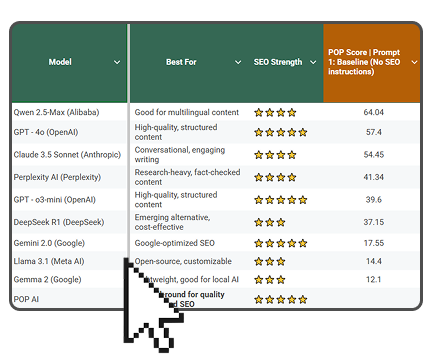
- Get the complete Gsheet report from our study
- Includes ChatGPT, Gemini, DeepSeek, Claude, Perplexity, Llama & more
- Includes ratings for all on-page SEO factors
- See how the LLM you use stacks up
What is Schema in SEO?
If you want to know what is schema in SEO, read on till the end of the blog. Schema, also known as schema markup or structured data, is a form of microdata that you can add to your website's HTML. This markup helps search engines understand the content of your pages better, providing more informative results for users. Schema was created by a collaborative effort between Google, Bing, Yahoo, and Yandex and is maintained at Schema.org.
Essentially, schema markup acts as a language that search engines understand. It provides context to the data on your web pages, allowing search engines to display rich snippets, which are enhanced listings that appear in search results.
How Does Schema Work?
Schema markup works by tagging specific elements on your webpage, such as product names, prices, reviews, and more, with descriptive tags. These tags help search engines categorize and display this information in a way that is more useful to users.
For example, if you have a recipe on your website, adding schema markup can highlight details like cooking time, ingredients, and nutritional information. This allows search engines to display this information directly in the search results, making your listing more attractive and informative.
Schema can be implemented using various formats, including JSON-LD (JavaScript Object Notation for Linked Data), Microdata, and RDFa (Resource Description Framework in Attributes). JSON-LD is the preferred method by Google due to its simplicity and ease of integration.
Which is the best LLM for SEO content?
Get the full rankings & analysis from our study of the 10 best LLM for SEO Content Writing in 2026 FREE!
- Get the complete Gsheet report from our study
- Includes ChatGPT, Gemini, DeepSeek, Claude, Perplexity, Llama & more
- Includes ratings for all on-page SEO factors
- See how the LLM you use stacks up
Benefits of Schema Markup
- Enhanced Search Results: Schema markup enables rich snippets, which enhance your search results with additional information such as images, ratings, and other relevant details. This makes your listing more attractive and can increase click-through rates (CTR).
- Improved SEO: While schema markup itself is not a direct ranking factor, it can indirectly improve your SEO by making your content more appealing and clickable in search results. Higher CTRs can signal to search engines that your content is valuable and relevant.
- Better User Experience: By providing users with more information directly in the search results, schema markup enhances the user experience. Users can quickly find what they are looking for, which can lead to higher engagement and lower bounce rates.
- Increased Visibility in Voice Search: With the rise of voice search, having schema markup on your site can help your content be more easily discovered and understood by voice search assistants like Google Assistant and Amazon Alexa.
- Competitive Advantage: Not all websites use schema markup, so implementing it can give you a competitive edge in the search results. Enhanced listings can help your content stand out from the competition.
Types of Schema Markup
There are hundreds of types of schema markup available, catering to various types of content and industries. Some of the most commonly used schema types include:
- Article Schema: Enhances the appearance of news and blog articles in search results, often displaying the headline, image, date, and publisher.
- Product Schema: Used for e-commerce sites, it includes information like price, availability, and reviews, making product listings more informative.
- Local Business Schema: Helps local businesses appear in local search results with details such as address, phone number, and operating hours.
- Recipe Schema: Ideal for food-related content, it highlights ingredients, cooking time, and nutritional information.
- Event Schema: Displays event details such as date, location, and ticket information, making it easier for users to find relevant events.
- FAQ Schema: Presents frequently asked questions and answers directly in the search results, enhancing the user experience.
How to Implement Schema Markup
Implementing schema markup on your website involves a few steps:
- Identify the Relevant Schema: Visit Schema.org to find the schema types that are relevant to your content. Each type has its own set of properties and attributes.
- Add Schema Markup to Your HTML: Use the chosen schema format (JSON-LD, Microdata, or RDFa) to add the markup to your HTML. JSON-LD is often recommended for its ease of use.
- Test Your Markup: Use Google's Structured Data Testing Tool or the Rich Results Test to ensure your markup is correctly implemented and free of errors.
- Monitor and Update: Regularly check your structured data in Google Search Console and make necessary updates to keep your markup accurate and relevant.
Best Practices for Using Schema Markup
To maximize the benefits of schema markup, follow these best practices:
- Accurate and Relevant Data: Ensure the information you provide in your schema markup is accurate and directly related to the content on your page. Misleading or incorrect data can lead to penalties from search engines.
- Keep Schema Updated: Regularly update your schema markup to reflect any changes to your content, such as new products or updated business hours.
- Follow Guidelines: Adhere to Google's guidelines for structured data to avoid any issues with your markup. This includes avoiding spammy or manipulative practices.
- Use JSON-LD: Whenever possible, use JSON-LD format for your schema markup. It is the preferred format by Google and is easier to implement and maintain.
Conclusion
Schema markup is a powerful tool in the SEO toolkit, offering numerous benefits from enhanced search results to improved user experience. By understanding what schema in SEO is and how to implement it, you can make your content more accessible and appealing to both search engines and users.
Incorporating schema markup into your SEO strategy can give you a significant advantage, helping you attract more targeted traffic and ultimately achieve your business goals. So, take the time to implement schema markup correctly and monitor its performance to ensure you are reaping the full benefits.
We analysed 11 industries. One averaged a POP Score of just 14.8 out of 100. Where does yours rank?
See how your industry compares, where the biggest gaps are, and which basics competitors still miss.


Kyle Roof is a Co-Founder & Lead SEO at POP, SEO expert, speaker and trainer. Kyle currently resides in Chiang Mai, Thailand with his family.