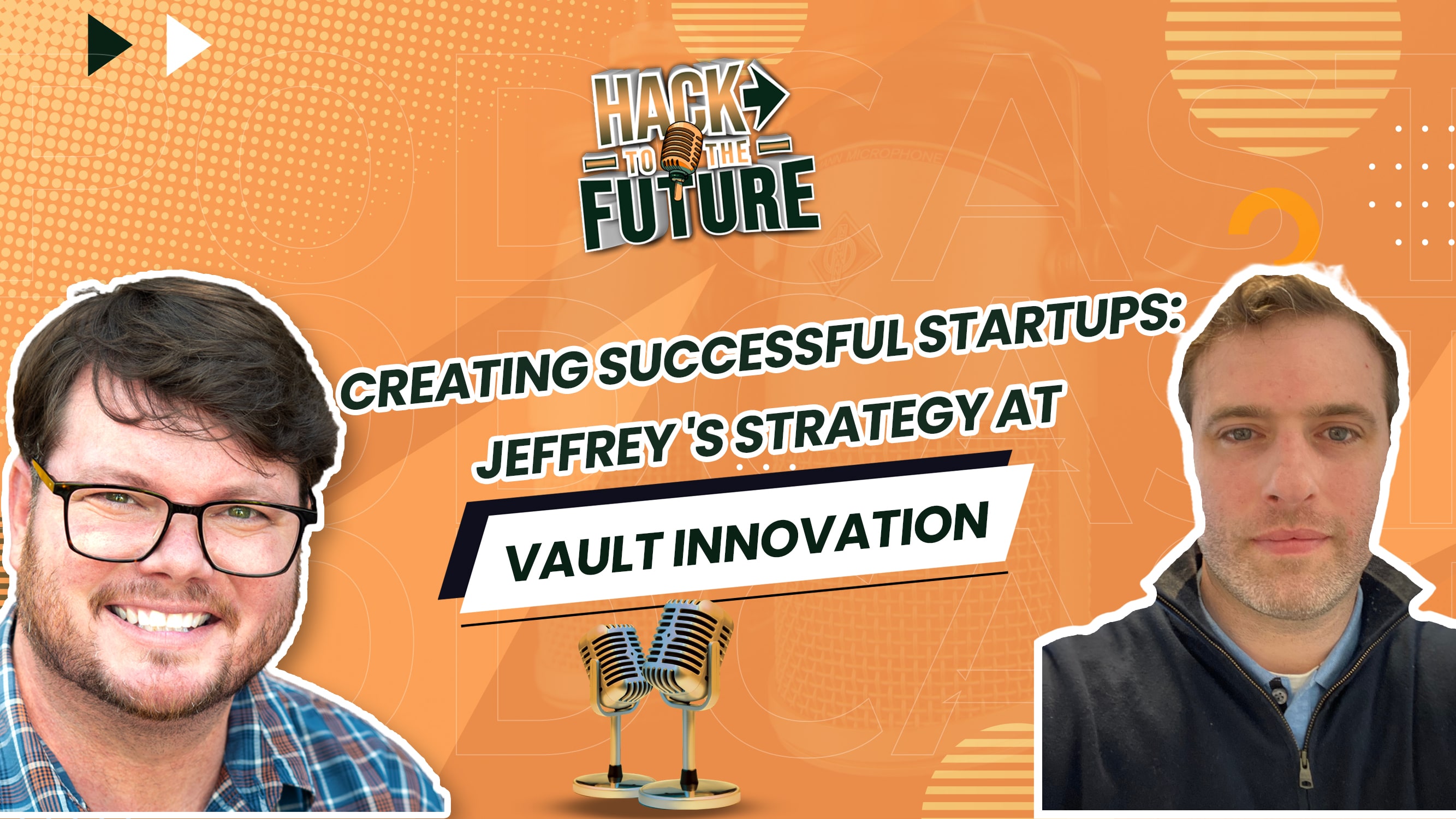
Creating Successful Startups: Jeffrey Dirrenberger's Strategy at VAULT Innovations
In this episode of "Hack to the Future with Kyle Roof," host Kyle Roof interviews Jeffrey Dirrenberger, founder and CEO of VAULT Innovations.
Jeffrey shares his 15+ years of tech industry experience and discusses his business model of combining technology partnerships with equity stakes. He explains VAULT's evolution from a venture-focused company to offering services and partnerships for entrepreneurs who lack technical expertise. Jeffrey emphasizes the importance of being a T-shaped professional, simplifying processes, and creating seamless user experiences. They also explore the impact of generative AI, onboarding, and customer experience, with Jeffrey encouraging the embrace of AI as an enabler.
Tune in to learn from Jeffrey's wealth of knowledge and get inspired by his approach to innovation, technology, and entrepreneurship.
TAKEAWAYS:
Jeffrey Dirrenberger emphasizes the importance of technology partnerships and equity stakes for startups, particularly for entrepreneurs lacking technical expertise.
VAULT Innovations initially focused on launching startups but has since evolved to provide services and partnerships to assist entrepreneurs.
Jeffrey highlights the value of being a T-shaped professional, possessing deep expertise in one area while having broad knowledge across other relevant fields.
Simplifying processes and creating seamless user experiences are crucial for the success of tech-driven businesses.
Jeffrey believes that improving existing technologies can be as impactful as creating entirely new ones.
He stresses the significance of the onboarding process and overall customer experience in retaining users and driving adoption.
The impact of generative AI is seen as an enabler, providing tools to enhance efficiency and productivity rather than replacing jobs.
Jeffrey notes the shift towards B2B services as a core focus for VAULT, offering more tangible results and requiring less marketing effort compared to B2C.
He points out that a key to successful startups is not just the technology but also the confidence to move forward and adapt.
Finally, Jeffrey encourages entrepreneurs to embrace AI and other technological advancements as tools to enhance their capabilities and drive innovation.

All right, welcome to Hack to the Future with Kyle Roof. I'm Kyle Roof and today with me is Jeffrey Dirrenberger, the founder and CEO of VAULT Innovations. Welcome Jeffrey, thanks for being here.

Yeah, no, thanks for having me, Kyle.
Jeffrey, you've got a pretty cool model where you partner with companies and I think you take a stake in that company through that partnership to bring in the technology aspect of what you do. Kind of walks us through the process. How does that happen initially? How does that conversation even start with a company?
Yeah, so I've done it all different ways, but I mean, I guess this is a quick background of it. I've been in the tech space for about 16, to 17 years. And so I started my career launching a startup in the esports gaming space with my brother and a couple of his friends. So I kind of started my first business many years ago. Throughout the process of running my business, you know, being a developer and a designer, helping other people kind of launch businesses. I started VAULT Innovation almost 11 years ago. And the vision was just to launch a bunch of startups. I saw so many people struggle and fail with their idea or business. And when you start asking why or how or what happened, you know, they, they really would struggle with the tech and that's why I kind of started VAULT to build my ventures, but then it sort of evolved into what other people need help building their ventures. Let me be their tech partner or their product partner. That's kind of how it started. Now it's evolved a lot since then and we've done a lot of different takes on it. But yeah, I mean a lot of people out there are, you know, what I like to call subject matter experts. Like they have expertise in a field, right? You know, they're a nurse that, you know, has worked in a hospital for 10 years. They're a teacher that's, you know, seeing the administration of the inside and how, you know, maybe bogged out it is or not, ineffective it is. So those are the kind of the key people that I would say, I have attracted over the years are people that know an industry, know in and out, have lived and breathe it. And then they, they want to change something, you know, they want to improve something, but they're not coders. They're not product people. And so that's really where we attract people at VAULT.
When they come to you, are they coming to you with the idea of, hey, I realize I don't have this expertise for the tech that I want to build, and they want that kind of equity partner? Or do they kind of come to you thinking this is more of a service situation that they want you to build, and then it kind of moves its way into that?
Yeah, it's a VAULT. It's really kind of all over the place, to be honest. But yes, I would say earlier in our existence at VAULT, we were all ventures. We were all, everyone that came to us, we were working on, either whether it was our venture or partnering with someone else as their partner or co-founder. As of the last maybe three or four years that's changed. We now just offer services. So I would say it's kind of both people come in and go, Hey, I need a tech partner. I'm looking for an equity partner. I can't do it. I don't know how to do it. But there are also a lot of people that go, Hey, I just need help building it. I need a good team. And sometimes I'll take exceptional interest in one and we figure out something creative to be partners with. But it's not something to do lightly. A partnership is like a marriage. You sign the paperwork, well you should, some people don't, but you should. And you are committing to a long-term thing. This is not like, hey let's go on a honeymoon and have some fun for six months because most businesses aren't making money in six months. So it is a long-term play. And so, you know, for us, when we're evaluating partnerships with companies, it's something that you evaluate, you know, it's something you think through and get to know the person and the team behind it. It's not, it's not just like, it was a good idea. Let's go. You got to get to know the founders.
For sure, I can see the situation where somebody comes in and it's like, I don't know about this idea. Maybe we're sticking to the services. That's not so much a partnership, for sure. So the people can know, give us the 30-second elevator on VAULT in terms of what kind of technology you gravitate towards or what's in your wheelhouse to build.
Yeah, and I mean, I so I did a lot of gaming stuff early in my career. So that was all beta sessions. A lot of it was B2C. There was B2B stuff in there, but I would build online league tools. I did dabble some stuff with action game development itself, game studio-type stuff. It's not done a lot of stuff in eSports and that is a little bit more B2C, but I would say I've kind of transitioned to more B2B. I think that's kind of our core focus as a team that's built on, you know, launching new products, there's a, there's a mindset there that is, I don't want to say formulaic. I mean, nothing is formulaic. There's a, there's a process there that's very formulaic, but it's very unique for each business. And the biggest thing that we like to focus on is kind of B2B. And so that's, it's a lot more tangible. You kind of know your target market and you don't need to. I would say in general, you don't need as much sort of marketing budget or marketing sort of power behind you to sort of take those first successful steps. And so, you know, B2C, you know, it could be an entertainment thing or something a little bit more subjective. And now you're you're kind of going, well, how does that take off? I mean, you have to have the right name, the right brand, the right experience. And so I think B2B is a little bit easier for an entrepreneur to sort of get to take off or get to lift off. So I would say that's what we focus on. So B2B service companies primarily where they're you know, technically providing the service without technology is common for us. And we build the technology to sort of, you know, make it a better experience, make it easier to use, make it so that people go, yeah, I want to do this. And then also we'll build SaaS companies. So software is a service company where, you know, the product is essentially the service. And so there isn't, there isn't a service component. It's a product, but B2B is where we focus.
When somebody comes to you, how much does your experience in business kind of bleed over into actually helping them in terms of like, not just building the technology, but maybe how to run a business effectively how to price things effectively, or different monetization strategies? Does that kind of play into this for you?
It does. And I, wrestle with this to me personally, just kind of what you just said there, like a lot of people, I would say, you know, technically come to my company more of like they're, they're waving the tech flag, you know, like, Hey, I need an engineer. I need a product team. But I would say, I mean, 8-9 times out of 10, just in a 10-minute conversation, 30-minute conversation, you're, you're backing it up, kind of going like, well, why, what, you know, what's the point? Have you talked to people? Have you had any customers? Once you start backing it up a little bit, you find that there's more they need to do than just build the product. And so, yes, me as an entrepreneur, I mean, the kind of the way that I build my team, we have 15 people on the team. The way that I look at anyone that's sort of doing this is you got to be kind of a T -shaped employee, T -shaped person, which is like, you know, there's a, there's the vertical side of the T, you have to have a very strong skill set in some core-focused things. You know, if you're an engineer or if you're sales or if you're a designer, whatever it is, but then you have to have that horizontal top of the T there where you do know a lot of other skills. I mean, you have to know about finances. You know, you have to know about selling. You have to know about HR and hiring and all those things to be an entrepreneur. So yes, I would say a lot of first-time entrepreneurs, we work with a lot of first-time entrepreneurs and they'll come in with a product, needing, waving their hand with, but they need all of it. And so the biggest thing I think that we do and help out a lot is we can kind of give that confidence and like, yes, this is the right path. Not that this is going to be the right outcome, right? I mean, you don't know what's going to happen a lot of times, but the confidence is like, hey, you don't need to bow the ocean. Hey, you don't need to overbuild. You don't linearly do this. Yes, go sell at this stage. Yes, this is a good price model to start. That's a really valuable part of our service is to help people kind of move through this rather than sort of freezing up every step of the way, right? It's like every step they take, it's like, man, am I pricing it too high? Am I pricing it too low?
we can kind of give that confidence on that side as well so that you can move. You know, you could keep going. I've seen so many people stall out and they get hung up on, well, I didn't launch the website because I don't like the logo or something. And you're like, well, that's not, you know, that's all different conversation, right? But yes, launching a business is way more than the tech. It's way more than the tech. And I would argue that tech is becoming less important. I mean, to be honest, I'd argue with it.
For sure. That makes an interesting point. What are things you've identified that those companies that make it versus those companies that don't? Maybe it's not exactly having the most wow tech, but maybe it's having something else. Or is there something that you can put your finger on that is kind of a common denominator for those who seem to make it and those who don't?
Yeah, I mean, it's all over the map to be honest, but my experience I've, I mean, I would say I've built a lot of software, not what I would call like kind of hard tech. And what I mean by that is like, I, you know, I'm not inventing like a new, you know, pacemaker to go in, you know, a biomedical device or some crazy new algorithm, right? Like I build software, I build companies that utilize software a lot. And so if you think about what software is, software, you know, uses AI and has all those things wrapped inside of it, but it's making an experience. You know, it's making something easier. It's making something faster. it's making something automatic, you know, whatever it is. So I mean, that's kind of the name of the game. So UX, I started my career as a UX. I mean, they didn't have that title back then, but I was a designer and UX was sort of my main, I guess, skill. And it was really like thinking about complex things and making it simple. And if you can do that as a business, fundamentally is if your business is doing that, you know, you've got a good chance to succeed. You know, back when I started my you know, as going through college and just being a young adult, there was always this thought of like innovation was like this huge leap forward of, you know like you invented something new. I mean, I have a mechanical engineering background and always loved physics and you know, the word invention was such a strong word for me growing up. And it was like, you know, you made something new, right? You made a new thing. But I think in tech and the way tech is so accessible now, it's not, it's not like you have to make something 10 years ahead. That might not even work because it's 10 years ahead. You're making something that maybe exists or has already happened. You're making it better. So the common thing that I see people do is do that. It's a little bit simpler. So one of our ventures was a digital wait list. Right? I mean, it's everywhere now. It's a commoditized service. But it would text you when your table was ready. But back when we built it, there wasn't one out there.
You know, it's a real simple thing and you would go to these rest of these like why would you not use this right? It's so simple and There are all these steps around getting them to use this technology that you have to break down So you can't just make it simple once they're in you've got to make it simple to buy Like, you know, hey, we're gonna give you the device. We're gonna give you the iPad, you know to put it on we're going to make it a super simple log and we're going to give it to you for free. Whatever is needed to just reduce the barriers is such a key part of innovation, specifically in tech.
I like that a lot, that the streamlining, the efficiency of things is just as innovative as the initial concept sometimes.
Yeah, and I mean, and I'll say this with a lot of companies that I meet after they've launched after, you know, they're live and they're like, well, we're having trouble or, you know, we need some help or change it up, whatever. And a lot of times people will think about the experience when someone's using it. But the experience to get them to start using it is just important. You know, what's that setup? What's that? Do I understand how to use this? And, you know, Apple was good at this. Apple still is very good at this. They're kind of the name name-brand the quote experience. I just went to Disney World. I just got back from Disney World with my family and they're kings of experience, you know, from sound, visual the perception of customization to you, even though it's not, right? And they do so much more than just like, well, hey, did you like this ride? It's like in the line waiting for the ride. It's the getting off the train to go. I mean, it's all of it. It's an experience. And that goes so well. I see so many early-stage startups that have that mindset of like, look, they're never going to get into the product unless they get onboarded correctly. It's easy to get through that point of activation and then they're off the races. So I see a lot of people neglect that because there's no experience with it. They never knew that that was a variable.
I saw an interesting thing where Disneyland had somebody increase the swipe time, like the swipe to processing time on the credit card machine. And everyone thought like, that's so cool because it gets people through the line faster so people can get their products back. But what Disney realized was that it allowed them to sell more. So it kind of gave that experience of, this is a great experience. I can't believe how fast that was. And I got my stuff. And now I'm on my way. Disney realized that they were losing money in the fraction of seconds that it was taking a normal processor to process the credit card. Same kind of thing. You get the experience and then at the same time that efficiency leads to much greater sales. Now we'll get to the portion of our show called, What's the Best Ride at Disney World? What's the best ride at Disney World, the best ride at Disney World?
There's a lot of debate, hot debate amongst the team here, but I think the winner, I have to say was a close tie between Guardians of the Galaxy and Tron and Avatar. Those are my three favorites. Those are just amazing rides. I loved Tron growing up as a kid and they have one at Disney, which is weird. You know, I don't think of that as a Disney brand, but it is. Those were awesome rides though. Just fun roller coasters, unique. And again, it's like you walk up to Tron and it's, it's not a ride. I mean, I've been to Six Flags, and been to Cedar Point, love Cedar Point, one of my favorite places. you know, it's just a ride. You go on the ride and the ride is awesome. There's a whole experience. I mean, you go into Tron, it's like that neon world. This music is very kind of dramatic and tense. You know, there's this pulsating kind of, you know, you feel like you're sort of in inside the, the matrix kind of thing. And they could have just made it a ride, but they made it an experience. So very cool stuff.
No, I completely agree. My little guy is nine. And while he's tall enough to do the rides, like the roller coasters, he doesn't want to do any of the roller coasters. So we end up doing more of the experience ride things. And so I'm now getting to those.
Yes. yeah, I know that. We had some kids in the family that were a little anxious as well.
Kind of looking forward to AI and AI is impacting industries in different ways. Is there anything that jumps out to you in the short term on how AI is affecting things versus maybe the long term?
Yeah, I mean, it's it is interesting. It's obvious. I mean, AI has been around for a long time. You know, the gen AI stuff when open AI, you know, release chat GPT 3.0, I believe it was like last fall, obviously game-changing stuff to the consumer. You know, it's interesting. I mean, I've been doing tech again for about 15 years. There's been a lot of technology evolution and, you know, there's been a lot of trends that have kind of died out trends but like technology right that just didn't take off and there's a little bit a lot of stuff that has and I mean every time something starts taking off there's this fear you know what is this gonna mean you know people are gonna lose jobs you know careers are gonna be over and that's I would say the gen AI boom right now it's very real number one I mean awesome tools amazingly awesome you can create so much stuff. But I mean, it's just another evolution. I wouldn't say this is like the, my God, this guy's falling thing. It's very exciting. It's very awesome. But I think from the day to day, like an entrepreneur, the day to day technologist, what I'm starting to see, and I don't think this is a hot take or anything, is that there are the people that are building that tech, that is building the LLMs and making these you know human experiences and then some people are using those tools to you know to build software around or on top of or whatever it is, right? And I think for the people that are that one percent or half percent or a quarter percent, you know, very small percent that is like really in the heavy part of it things are just blowing up rocket ship to the moon and these people are doing things that they've never been able to do but for the rest of the people Yes, we're getting answers quicker. Yes, you can build things quicker. The stable diffusion stuff is insanely awesome. You know, you can build websites. You can like port websites. I mean, you can do all this as well. But it's now just new tools and you got to be able to use them. You know, there's no question you got to learn how to use them. Some people can do it better than others and there's becoming a gap there. But it's exciting. I think it's just enabling people to make more stuff and make more content.
Yeah, I mean, it's it is interesting. It's obvious. I mean, AI has been around for a long time. You know, the gen AI stuff when open AI, you know, release chat GPT 3.0, I believe it was like last fall, obviously game-changing stuff to the consumer. You know, it's interesting. I mean, I've been doing tech again for about 15 years. There's been a lot of technology evolution and, you know, there's been a lot of trends that have kind of died out trends but like technology right that just didn't take off and there's a little bit a lot of stuff that has and I mean every time something starts taking off there's this fear you know what is this gonna mean you know people are gonna lose jobs you know careers are gonna be over and that's I would say the gen AI boom right now it's very real number one I mean awesome tools amazingly awesome you can create so much stuff. But I mean, it's just another evolution. I wouldn't say this is like the, my God, this guy's falling thing. It's very exciting. It's very awesome. But I think from the day to day, like an entrepreneur, the day to day technologist, what I'm starting to see, and I don't think this is a hot take or anything, is that there are the people that are building that tech, that is building the LLMs and making these you know human experiences and then some people are using those tools to you know to build software around or on top of or whatever it is, right? And I think for the people that are that one percent or half percent or a quarter percent, you know, very small percent that is like really in the heavy part of it things are just blowing up rocket ship to the moon and these people are doing things that they've never been able to do but for the rest of the people Yes, we're getting answers quicker. Yes, you can build things quicker. The stable diffusion stuff is insanely awesome. You know, you can build websites. You can like port websites. I mean, you can do all this as well. But it's now just new tools and you got to be able to use them. You know, there's no question you got to learn how to use them. Some people can do it better than others and there's becoming a gap there. But it's exciting. I think it's just enabling people to make more stuff and make more content.
And then there's just like anything else, there's going to be a bar or a gap that goes, there's going to be people that master it and know how to do it. And there's going to be the people that just like, hey, tell me how to use it. I'll use it as a tool. So from the start, from like the startup business perspective, I've seen, obviously there's a huge AI boom in terms of investment and exits and all that stuff, but it's a very weird market right now in tech. I know a lot of people that don't have jobs have gotten laid off, you know, are kind of what's going on. And some of it is a little bit of AI evolution, but it's not really that I think it's just evolving in general. I mean, as I said, I asked my wife, so we have three kids and I asked my wife, you know, what, what do you think would be more important for our kids to, I mean, should they even go to higher education at this stage? You know, what is college all that? Should they study like writing and marketing or should they study computer science and engineering? And you know, I think 10 years ago that question was like, that's the dumbest question. Of course, it's engineering, you know, courses, computer science. I don't know if it's as simple as that anymore. I mean, being able to communicate, and articulate your thoughts. Yes, Gen. AI is helping you do that, but you still need to prompt it. You still need to control it and you know, make it do what you want it to do in a way. And I still think that's going to be the king. So it's exciting. It's awesome. And it's a little unknown, but AI has been around for a long time. The Gen. AI stuff is awesome and everyone should be using it. I mean, entrepreneurs shouldn't be afraid of it. Service providers shouldn't be afraid of it. It's something that's going to enhance the people that want to be enhanced and the rest of the people, you know, you're going to use the tools that the other people are enhancing. So, I mean, I think it's just kind of an evolution. I remember when the smartphones came out, the iPhone came out, it was like, okay, am I going to switch building websites and web apps and start building another language and mobile apps? And you're kind of like, I don't know if there's really good use case for that. And you started doing it because people wanted it, you know, it was a thing that people needed. So people need it. People want that, that customer support, that experience, that better experience. And so it's here to stay. It's just another evolution though. I'm not like psyched out about it like, my god, the world's ending. It's an evolution of technology.
You know, to your point, I bet the best prompt engineers are probably English majors or philosophy majors. You know?
Yeah, I mean, it's whatever is said it's attention to detail. I remember when Google started becoming mainstream, it was like 20-some years ago now. You know, I remember there was a meme that went around, like someone asked you a question and they would, you could type in your question into Google and it would create a little GIF and you'd send it out and be like, just Google it. The answer is right there. Why are you asking me? Because it's again, just people don't know and they don't have the confidence to do it. It's going to continue to be that way. So I'm excited for it. I can't, I can't wait to see the next levels of it, to be honest. I mean, right now it's really exciting, but it's still so far to go where, you know, we're in that true sci-fi, you know, world.
Yeah, it can go any direction. And I think what's exciting though is all of this is still the Wild West. You don't need a degree necessarily in a lot of this or any kind of certification. You can just start doing it and you can make a lot of money, be very successful. Well, Trevor, thanks so much for being on it. I appreciate it. If people want to get in touch, how can they get in touch with you?
Yeah, I'd love to chat with anyone to hear about an idea they're cooking up or any way I can help, again, launch a business or even optimize their business. But yeah, you can reach out to me via email, Jeffrey@vaultinnovation.com. Go to the website vaultinnovation.com. We have resources on there for entrepreneurs to look at, to help them out with some of the topics we've been talking about, but obviously can ping me on LinkedIn as well. So.
Awesome, thanks so much. We'll put all those links in the description, of course. And thanks everyone for listening. We appreciate you being on and we'll talk to you next time. Thanks so much.
But yeah, it was awesome being on your Kyle and chatting with you.
All right, take care.
Listen on: